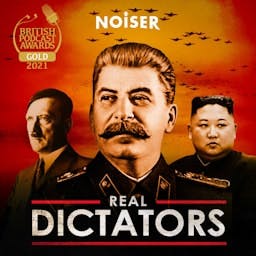
Real Dictators is the award-winning podcast that explores the hidden lives of history's tyrants. Hosted by Paul McGann, with contributions from eyewitnesses and expert historians. New episodes available a week early for Noiser+ subscribers. You'll also get ad-free listening, ear…
Trujillo's spectacle of power masked total corruption; the Galíndez and Mirabal murders broke his US patronage, and CIA-armed conspirators assassinated him in 1961, leaving a legacy of fear and nostalgia.
Rafael Trujillo's rule fused a statue-saturated cult of personality, sexual terror, and the 1937 Parsley Massacre of ~12,000 Haitians — atrocities he survived via US lobbying, refugee PR, and Cold War anti-communism.
How Rafael Trujillo rose from petty criminal and sugar-estate guard to dictator of the Dominican Republic through a US-trained National Guard, a rigged 1930 election, and the crisis cover of Hurricane San Zenón.
A historical analysis of Octavian/Augustus's rise from Caesar's adopted heir to Rome's first emperor. It explores how he dismantled the Roman Republic while preserving republican facades, his 45-year reign of expansion and propaganda, his troubled succession involving multiple suspicious deaths, and his contested legacy as both civilizing statesman
This episode traces Octavian's transformation from Caesar's teenage heir into sole ruler of Rome between 44–30 BC. Through political alliances, the bloody Second Triumvirate, proscriptions, and military victories at Philippi and Actium (won largely by Agrippa), he systematically eliminated rivals including Antony, Cleopatra, and Caesarion. The narr
This episode traces the dramatic transition from Julius Caesar's assassination on the Ides of March, 44 BC, to the moment his sickly 18-year-old grand-nephew Octavian inherits his name, fortune, and legions. It argues that despite chronic illness and no military talent, Octavian's political genius positioned him to become Augustus, the first Roman
This episode chronicles the twilight years of Yugoslav President Josip Broz Tito, from his 1971 hosting of Hollywood stars to his 1980 death. It examines his leadership of the Non-Aligned Movement, his pioneering hybrid market-socialist economy, and the rising ethnic nationalism that ultimately tore Yugoslavia apart after his passing.
This episode examines Josip Broz Tito's brutal consolidation of power in post-WWII Yugoslavia, including the mass killings of returning Ustasha and Chetnik refugees, the show trial execution of Mihailović, and the establishment of his secret police state. It details the Tito-Stalin split of 1948, surviving 22 Soviet assassination attempts, and ulti
This episode explores Josip Broz Tito's leadership of Yugoslavia's WWII Partisan resistance, from the 1941 Nazi invasion through the 1944 liberation of Belgrade. It covers the Ustashe genocide, the brutal civil war between partisans and Chetniks, Churchill's secret mission to assess Tito, and Yugoslavia's unique self-liberation.
This analysis covers the volatile creation of Yugoslavia after WWI, tracing Josip Broz's rise as the communist leader Tito amidst ethnic strife and a royal dictatorship. It culminates in a 1941 coup against a Nazi pact, triggering Hitler's invasion.
Tito's 1980 death at a football match opens an exploration of his legacy as Yugoslavia's unifier. It traces his origins as Josip Broz, a peasant's son captured in WWI Russia. The Revolution transformed him into a communist ready to build Yugoslavia.
Colonial sentiment shifted from royal devotion to revolutionary fervor due to economic and religious changes. Grassroots resistance and military occupation in Boston accelerated the divide. This complex struggle involved a diverse cast beyond just the elite founders.
The 789 AD Dorset raid and 793 Lindisfarne attack launched the Viking Age. Beyond barbarian stereotypes, these Norse were sophisticated navigators, traders, and explorers driven by politics, religion, and commerce. Advanced ships enabled vast expansion, though victim-written sources obscure their complex legacy.
The rise and fall of Jean-Bédel Bokassa highlights the extremes of post-colonial dictatorship. His lavish coronation and brutal suppression of protests led to a French-backed coup. He remains a complex symbol of stability for some.