 5:35
The Diamond Market is Collapsing. Here's Why
Watch
The video explains why the diamond market is collapsing, attributing the decline to science rather than fashion or the economy.
Watch on YouTube PodPulse

As simple as possible, but not any simpler! Science and technology updates and summaries. No hype, no spin, no tip-toeing around inconvenient truths. Currently 5 videos a week (Tue-Wed-Thu and Sat-Sun). Early access for channel members. Sabine Hossenfelder has a PhD in physics.…
5:35Watch
The video explains why the diamond market is collapsing, attributing the decline to science rather than fashion or the economy.
Watch on YouTube 6:57
A look at the trend of people outside academia using AI to write physics papers and what it could mean for science.
 7:23
Watch
Sabine Hossenfelder discusses how AI models improved on a reasoning test from below 1% to over 60% in six months, and whether this means AI is finally intelligent.
Watch on YouTube 6:51
Watch
Sabine Hossenfelder examines a University of Ottawa physicist's claim that the universe is 26.7 billion years old and contains no dark matter or dark energy.
Watch on YouTube 6:51
Watch
The creator discusses recent scientific findings about how AI works and a conclusion that may make AI harder to keep safe.
Watch on YouTube 6:42
Watch
The creator discusses a particle-physics anomaly in which two experiments measure the same quantity but obtain different answers.
Watch on YouTube 6:12
Watch
The video looks at Sabrina Pasterski's celestial holography work and what it tells us about quantum gravity, including claims about unifying gravity and quantum theory.
Watch on YouTube 5:51
Watch
The video discusses a new paper from physicists offering a surprising explanation for why our universe exists in a false vacuum state.
Watch on YouTube 6:44
Watch
The video discusses how SpaceX's dominance in rocket launches is creating a launch crisis, affecting Amazon's satellites and Europe's defence.
Watch on YouTube 6:51
Watch
Sabine Hossenfelder examines recent scientific papers that use quantum physics to explore paranormal topics such as consciousness after death and déjà vu from another universe.
Watch on YouTube 8:03
Watch
The video argues that inaction, rather than regulation, may be the biggest threat to artificial intelligence and could stall AI progress.
Watch on YouTube 6:16
Watch
Sabine Hossenfelder examines assembly theory, a method researchers developed to quantify complexity, and the group's claim that it addresses a major problem in the search for alien life.
Watch on YouTube 6:08
Watch
The creator examines a long-standing anomaly in particles containing bottom quarks, described as having reached 4.8 sigma, just short of a discovery.
Watch on YouTube 6:30
Watch
The video examines new papers challenging the standard decoherence explanation for why quantum fluctuations did not leave galaxies in two places at once.
Watch on YouTube 6:39
Watch
The video discusses what a useful quantum computer would look like and what it would be used for, referencing a new calculation and a $5 million prize.
Watch on YouTube 7:24
Watch
The video examines AI‑written physics papers on new particles, dark matter and the fine‑structure constant, and the differing reactions from OpenAI and physicists.
Watch on YouTube 7:05
Watch
The video reviews Erwin Schrödinger’s surfaced diaries and the different story historians say they tell.
Watch on YouTube 6:40
Watch
The video examines a claim that unusual Large Hadron Collider data may point to an extra dimension, along with problems with that interpretation.
Watch on YouTube 7:18
Watch
The video examines claims about how long plastic lasts and discusses recent research the creator says tells a different story.
Watch on YouTube 7:14
Watch
Sabine Hossenfelder reviews a new US National Academies report on extreme weather attribution that has drawn sharp criticism from climate sceptics.
Watch on YouTube 5:49
Watch
The video examines the state of small modular nuclear reactors, noting government investment alongside startup bankruptcies.
Watch on YouTube 6:27
Watch
Sabine Hossenfelder reviews a 14-year-old from Canada who won a prize for a new theory of dark energy.
Watch on YouTube 6:31
Watch
Sabine Hossenfelder explains why astronomers have found a green star, despite stars hot enough to be green typically appearing white.
Watch on YouTube 6:37
Watch
The video reviews a proposed explanation for the Hubble tension involving early-universe magnetic fields and the interpretation of the cosmic microwave background.
Watch on YouTube 6:42
Watch
The video discusses a Princeton study finding that global warming may lead to fewer tropical cyclones, while noting that fewer storms does not necessarily mean better outcomes.
Watch on YouTube 6:55
Watch
The video examines carbon capture and storage, government investment in the approach, and whether it works.
Watch on YouTube 6:18
Watch
The video reviews a group of biologists’ view that current AI models are far from consciousness and the properties an artificial system would need to become more brain-like.
Watch on YouTube 6:20
Watch
The creator examines new measurements of outer-star motion that do not fit either the Milky Way’s dark-matter-halo picture or the modified-gravity alternative.
Watch on YouTube 12:14
Watch
Artificial superintelligence will likely become a restricted tool for the elite rather than a universal resource. Physical constraints will lead to centralized mega-brains that drive inequality. This mirrors the Industrial Revolution's power shifts.
Watch on YouTube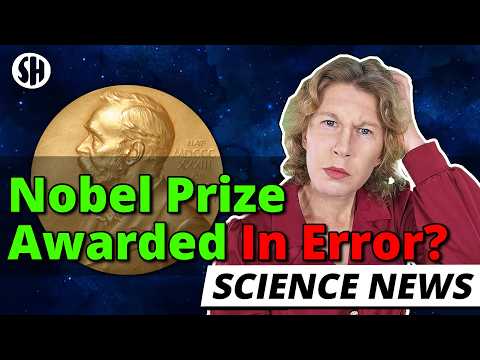 7:11
Watch
Physicists are debating if the universe's expansion is truly accelerating. Recent studies suggest that galaxy age, rather than dark energy, may explain supernova data. This controversy challenges the validity of the 2011 Nobel Prize.
Watch on YouTube 7:28
Watch
Nuclear fusion startups are struggling to meet ambitious energy goals. Many firms are pivoting to selling secondary technologies like lasers to satisfy investors. Repeatedly delayed timelines suggest commercial fusion remains decades away and potentially very expensive.
Watch on YouTube 7:02
Watch
Theoretical physics suggests entangled particles are linked by wormholes. A new study tests this by measuring energy levels in hydrogen atoms. The findings show no evidence of physical links, suggesting the idea is a mathematical metaphor.
Watch on YouTube