 8:40
Can the sum and the product of two functions both equal e^x?
Watch
A math video exploring whether two functions can have both their sum and product equal to e^x.
Watch on YouTube PodPulse

Sharing the fun of solving math problems!
8:40Watch
A math video exploring whether two functions can have both their sum and product equal to e^x.
Watch on YouTube 10:06
The video demonstrates solving the cubic equation x^3+2x^2+3x+4=0 using the complete cubic formula and trigonometric substitution.
 1:26:13
Watch
A calculus tutorial solving 8 volume-of-revolution problems using both the disk/washer method and the cylindrical shell method on the same solids.
Watch on YouTube 6:35
Watch
The video covers solving the function composition equation f(f(x))=0 for a quadratic f(x)=ax^2+bx+c, using substitution to break it into two quadratic passes.
Watch on YouTube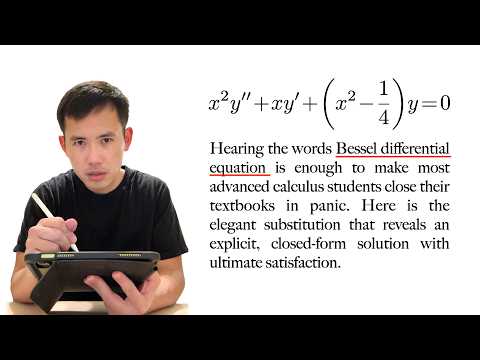 22:49
Watch
A video about solving Bessel's differential equation of order one-half using a substitution to obtain a closed-form solution.
Watch on YouTube 8:28
Watch
A step-by-step comparison of disc and cylindrical shell methods for rotating y=sin(x^2), including a u=x^2 substitution.
Watch on YouTube 6:10
Watch
The video considers whether logarithms can be used to solve a quadratic equation, following the creator's unsuccessful attempts.
Watch on YouTube 8:24
Watch
The video shows a "false proof" of 1=2 without dividing by 0 and covers a geometric proof of a cosine difference identity.
Watch on YouTube 3:57:54
Watch
A math educator works through 100 polynomial factoring problems in one continuous session, demonstrating every key technique from GCF and difference of squares through synthetic division, the double cross method for quartics, Sophie Germain's…
Watch on YouTube 1:08:54
Watch
A math video presenting 10 rational function problems covering asymptotes, inverses, partial fractions, and Möbius transformations.
Watch on YouTube 4:16
Watch
A math video that finds the derivative of y^y = x and uses the Lambert W function to simplify the result.
Watch on YouTube 1:37:32
Watch
A walkthrough of 20 Calculus 1 optimization problems covering setup patterns like distance minimization, area and perimeter constraints, cost and revenue, and trigonometric models.
Watch on YouTube 1:22:10
Watch
A 20-question precalculus practice test covers polynomial and rational functions, including asymptotes, inequalities, division, roots, graphing, limits, and transformations.
Watch on YouTube 7:53
Watch
A calculus instructor accidentally discovers that the minimum combined area of an equilateral triangle and square formed from a 10m rope is approximately 2.71852, remarkably close to the number e. The optimization problem leads to an exact answer of 25/(11+3√3), which approximates e to within 0.0001. This serendipitous finding beautifully connects
Watch on YouTube 5:57
Watch
A student asks to prove sec θ = cosh x given x = ln(sec θ + tan θ). The speaker initially struggles forcing the proof forward. They discover working backwards from cosh x's exponential form is much easier, using conjugate multiplication and the identity sec²θ − tan²θ = 1.
Watch on YouTube 6:49
Watch
Comparing equations with no real solutions, the speaker shows x = x + 1 has no complex roots while √x = x + 1 yields (-1 ± i√3)/2. These complex roots connect to cube roots of unity. The discussion proves algebraic methods, not graphs, determine whether complex solutions exist.
Watch on YouTube 4:30
Watch
The speaker derives formulas for exponential equations similar to the quadratic formula. They solve c^(2ax+b)=d using logs, then derive a general solution for a^(bx+c)=d^(ex+f). The tone is enthusiastic, celebrating mathematical creativity and discovery.
Watch on YouTube 12:55
Watch
The quadratic formula is derived using complex numbers and Euler's formula. Substituting x in polar form into the standard equation and separating real and imaginary parts reveals the vertex formula. Trigonometric identities then lead to the familiar solution.
Watch on YouTube