You can gain access to a world of education through Stanford Online, the Stanford School of Engineering’s portal for academic and professional education offered by schools and units throughout Stanford University. https://online.stanford.edu/ Our robust catalog of degree program…
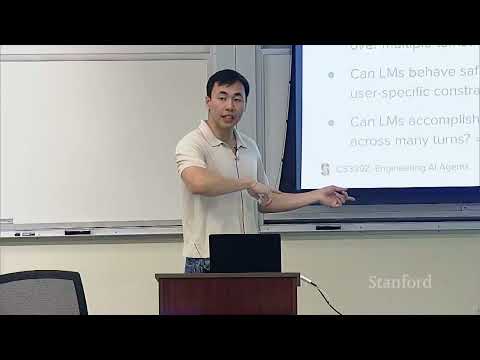
Fireside chat with Andrew Ng and Diyi Yang at Stanford CS329Z covering AI agent building, error analysis, evals, and the gap between verifiable and judgment tasks.
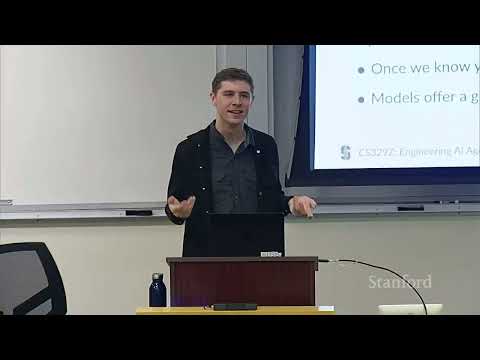
A Stanford CS329Z lecture by John Yang on designing benchmarks for AI agents, covering evaluation frameworks, task formulation, protocols, and properties of good benchmarks.
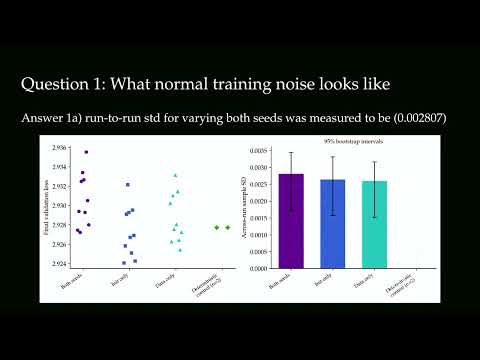
Stanford CS312 quiz review with PhD student Suhas Kotha covering seed variance, warmup, WSD decay, parameter norms, and scaling-law extrapolation on the d8 language model.
Stanford CS329Z lecture by John Yang on training data for AI agents, covering trajectories, environments, data collection strategies, and pitfalls like reward hacking.
Stanford statistics professors Kristin Sainani and Regina Nuzzo explain p-values using a number-guessing experiment, covering the null hypothesis and common misinterpretations.
Stanford CS312 Lecture 1 introduces teaching deep learning through prediction quizzes, with Hashimoto and Kotha covering pre-training and the d8 model organism.
A Stanford CS547 HCI seminar lecture on applying CSCW theories to coordinate human and AI agent activity, covering four systems and institutional design.
Stanford CS193T lecture by Senior Lecturer Cynthia Bailey covering AI usage costs in tokens, dollars, electricity, and water, plus model selection and API key security.
Stanford CS329Z lecture by Michael Ryan on optimizing AI agents, comparing prompt optimization methods (GEPA, MIPROv2, TextGrad) with weight optimization approaches (SFT, GRPO, PPO).
Stanford CS193T Lecture 6 with Senior Lecturer Cynthia Bailey covers vibe coding with Claude Code and Codex, post-deployment AI monitoring, the NIST AI Risk Management Framework, and AI evaluation methods.
A Stanford CS329Z lecture on multi-agent systems, covering when to use one agent versus many, orchestration patterns, communication protocols, and coordination tools.
A Stanford CS329Z lecture comparing DSPy and LangGraph for building AI agents, with live coding, agent harnesses, durable orchestration, observability, and evals.
Stanford CS193T guest panel with researchers from English, Law, and Bioengineering discussing how they use AI in their fields and what responsible AI use means in academia.
An opening lecture from Stanford's CS193T course that introduces how large language models work, covering tokens, neural networks, training, inference, and common AI failure modes.


 20:47