The Institute for Advanced Study is one of the world's leading centers for theoretical research and intellectual inquiry. The Institute exists to encourage and support fundamental research in the sciences and humanities—the original, often speculative thinking that produces adva…
Jacqueline Caminiti presents an IAS seminar on the spectral KSW criterion, a proposed weaker admissibility condition for quantum field theories on complex spacetimes.
Henry Yuen delivers a seminar on quantum cryptography, covering quantum key distribution, unclonable tokens, and quantum position verification, with speculation on links to AI safety.
Ibrahim Trifa explains a multidimensional Birkhoff theorem for a new class of C0 Lagrangians, including continuous-graph images under C1 exact symplectomorphisms.
A seminar by Massimiliano Berti exploring whether KAM theory can be integrated into modern symplectic dynamics, covering quasi-periodic functions and Hamiltonian PDEs.
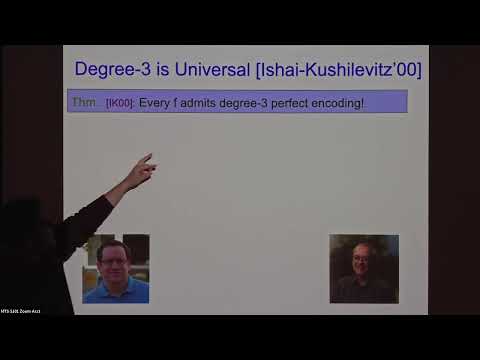
Benny Applebaum presents a degree-2 randomized encoding for all functions with statistical privacy, resolving an open problem from Ishai and Kushilevitz's FOCS'00 paper.
Jill Lepore discusses constitutional amendment and originalism, the history of technocracy, and the politics of technology at the Institute for Advanced Study.
Daniil Rudenko gives a Members' Colloquium talk on a connection between polylogarithms and algebraic K-theory, using homotopy theory of general linear groups.
Bailey Flanigan presents work on collective decision-making over complex outcome spaces, arguing that element-level preference elicitation cannot capture global priorities, and discusses participatory budgeting applications.
Shuhao Li presents an open-closed string topology approach to Lagrangian submanifold topology and Maslov class rigidity in the standard symplectic vector space C^n.
Jun Zhang delivers a research seminar on the shape invariant, a non-linear symplectic capacity for four-dimensional Euclidean domains, and its applications.
Marius Fischer discusses optimal L4-norm bounds for automorphic forms on arithmetic hyperbolic surfaces, focusing on levels p^n and comparisons with the spectral aspect.
A learning seminar explains the differential-topological basis of integer-valued curve counting, including FOP perturbation, FOP transverse maps, and integral cycles.
Jared Marx-Kuo discusses constructing group-invariant minimal hypersurfaces using min-max methods and Allen-Cahn regularization in cohomogeneity 2 and higher.
A seminar talk on universality in AdS/CFT, covering the semiclassical limit, large N gravitational regimes, high-energy spectra, and connections to random matrix theory and number theory.
Jinxin Xue presents a proof of Aubry's completeness conjecture and links Aubry-Mather theory, the Hubbard-Wigner model, and fractional quantum Hall effects.

 1:07:09