 4:00
Machine Learning Designs Cheaper, Greener Ceramic Tiles
Watch
The video covers an IMMI paper using machine learning and inverse design to develop cheaper, lower-CO2 ceramic tile recipes, validated on 18 fabricated batches.
Watch on YouTube PodPulse

I'm a Professor of Materials Science & Engineering at the University of Utah. I'm passionate about engineering education. I love making tutorials and example problems. Just comment an any video with a request for a new problem or explanation and I'll make it happen.
4:00Watch
The video covers an IMMI paper using machine learning and inverse design to develop cheaper, lower-CO2 ceramic tile recipes, validated on 18 fabricated batches.
Watch on YouTube 3:41
Watch
A Materials Minute episode examining whether Bayesian-optimized coarse-grained Martini 3 models can predict polymer blend miscibility, based on a new IMMI paper.
 3:41
Watch
The video discusses ForgeNet, a neural-network surrogate that predicts metal deformation in open-die forging faster than conventional finite-element simulation.
Watch on YouTube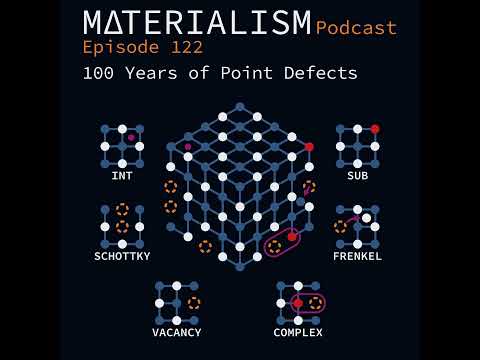 43:03
Watch
The episode explores the history, measurement, and future of point defects, with Dr. Mike Scarpulla discussing how missing or misplaced atoms enable technologies.
Watch on YouTube 10:26
Watch
A walkthrough of XRD search/match and phase identification, including databases, software steps, figure-of-merit scores, incorrect top hits, and a six-step workflow.
Watch on YouTube 4:21
Watch
The video examines how manufacturing variation can make coating damage risks invisible in smooth, idealized models.
Watch on YouTube 5:23
Watch
The video covers HELIX, a Johns Hopkins automated platform for laser-driven micro-flyer impact experiments using computer vision and real-time feedback.
Watch on YouTube 10:01
Watch
The video explains how EBSD reveals crystal grains, orientations, phases, texture, and strain in metals, using copper as the example.
Watch on YouTube 10:08
Watch
The video builds Bragg’s law from wave interference and crystal geometry, then shows how to interpret X-ray diffraction patterns.
Watch on YouTube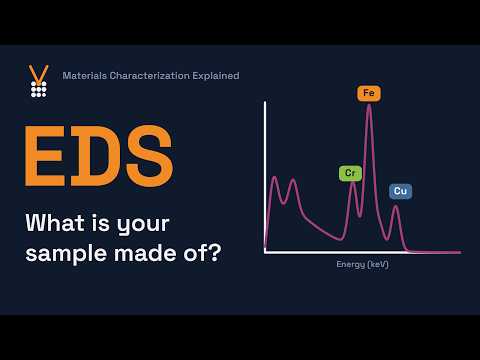 11:57
Watch
An educational video explaining how energy dispersive spectroscopy (EDS) reads chemistry from X-rays in a scanning electron microscope.
Watch on YouTube 10:50
Watch
An explanation of why SEM images look side-lit, covering electron signals, detectors, charging, and imaging a fractured steel sample three ways.
Watch on YouTube 9:50
Watch
The creator walks down an SEM column, explaining its electron source, lenses, scanning system, vacuum, imaging controls, and the trade-offs behind each setting.
Watch on YouTube 4:32
Watch
A Materials Minute exploring how spherical nanoindentation, crystal-plasticity simulations, and Bayesian inference can measure grain-scale mechanical properties in a nickel-based superalloy.
Watch on YouTube 11:31
Watch
A practical explanation of whole-pattern Rietveld refinement, organizing parameters by peak position, shape, and intensity.
Watch on YouTube 4:30
Watch
A Materials Minute episode walking through an IMMI paper on a hybrid quantum-classical model for predicting lithium prices across volatility regimes.
Watch on YouTube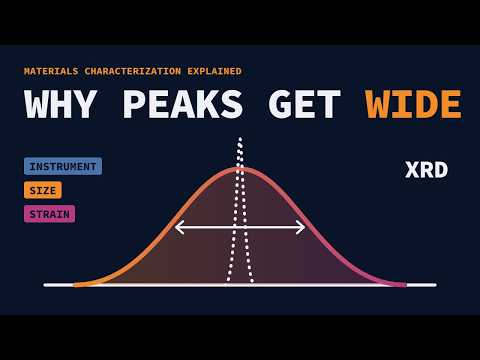 8:05
Watch
The video explains why XRD peaks broaden, covering peak-width measurements, instrumental and wavelength effects, crystallite size, microstrain, and Williamson–Hall analysis.
Watch on YouTube 9:18
Watch
An animated explainer traces X-ray diffractometer optics from source to detector, showing how slits, filters, mirrors, and detectors affect beam intensity, resolution, background, and spectrum.
Watch on YouTube