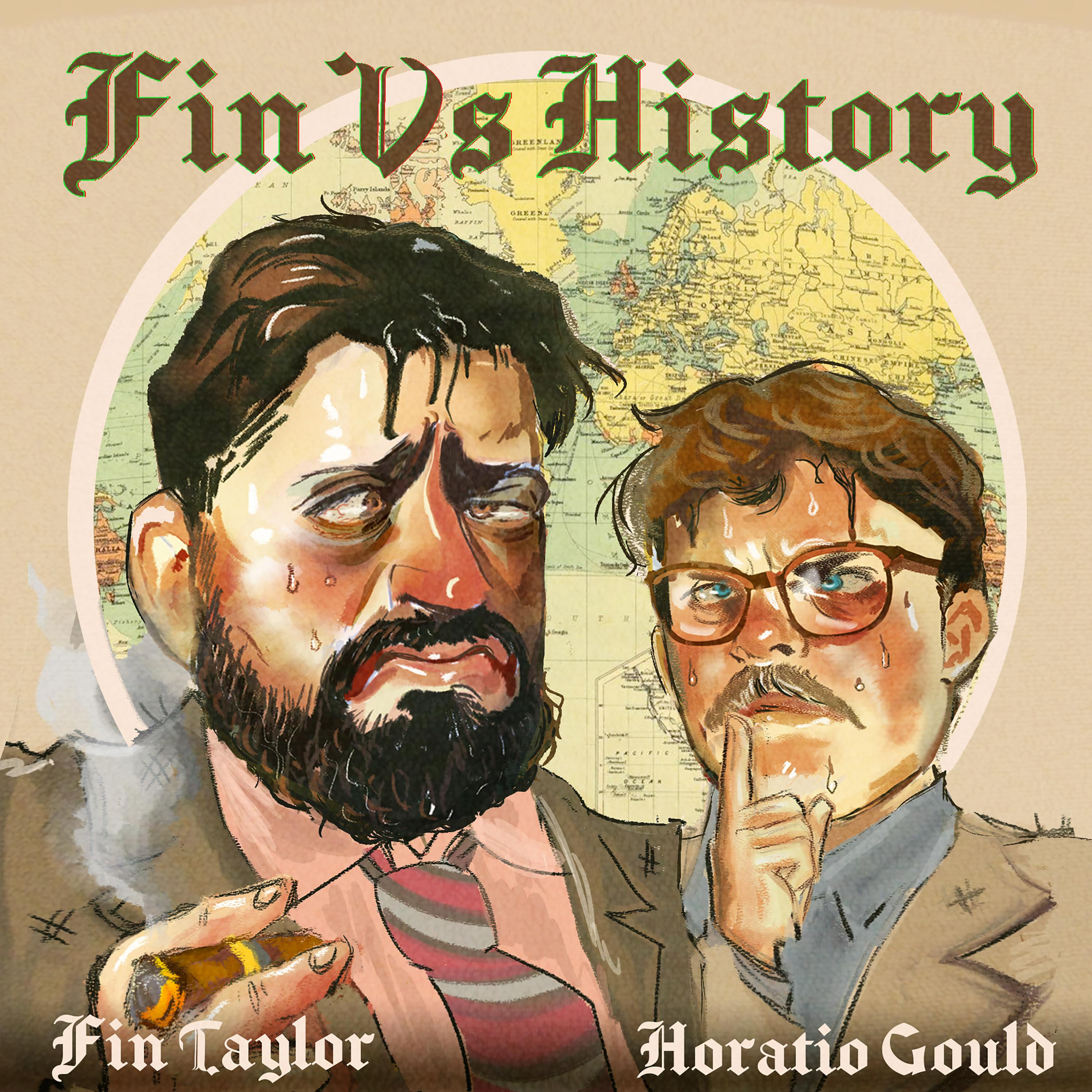
For people who like history but don't care what actually happened.Join comedians Fin Taylor and Horatio Gould as they guess/explain every event in human history, from Neanderthals to 9/11.Guaranteed to give you an entirely new and incorrect perspective on world events.Support th…
A satirical history podcast reads Deuteronomy, Joshua and Judges as a divine conquest blueprint — herem annihilation, Jericho, Samson — and links it to revisionist Zionism's Iron Wall, while noting archaeology doesn't verify the battles.
A comedic history podcast walks through Exodus and Numbers, arguing the twelve spies story is the biblical blueprint for Zionism, from Herzl to Jabotinsky and Netanyahu's revisionist 'iron wall' ideology.
The hosts of Finn Versus History declare themselves Christian Zionists after reading the Old Testament, using crude humor and anthropological interpretations to argue the text justifies modern Jewish nationalism and Israeli statehood.
Seven bungling teenage assassins and a chauffeur's wrong turn let Gavrilo Princip gun down Franz Ferdinand in 1914, triggering the alliance cascade that ignited World War I.
A comedic history podcast traces how Serbian nationalism, the Black Hand, and a collapsing Ottoman Balkans set the stage for Gavrilo Princip's plot — with the irony that Franz Ferdinand was a moderate reformer.
Comedians retell the Lindy Chamberlain case: a 1982 murder conviction built on flawed forensics and prejudice, undone by a matinee jacket found in dingo lairs and a 2012 coroner's finding.
The 1980 disappearance of Azaria Chamberlain at Uluru spirals into a media-fueled witch hunt against her mother Lindy, exposing how gender bias, religious prejudice, and public demand for performative grief override forensic evidence and delay…
This analysis explores how the English longbow and the muddy terrain of Agincourt allowed a sick, outnumbered force to destroy the French nobility, blending historical facts with the grim reality of medieval warfare.
The hosts frame the Battle of Agincourt as the purest English underdog story, contrasting a psychopathic Henry V with a decadent French court, while heavily relying on crude humor and modern analogies.
After WWII, Joseph Stalin transitioned from a wartime victor to a paranoid recluse whose weaponization of social humiliation and distrust of medical professionals ultimately led to his isolated death and the subsequent de-Stalinization of the…
A comedy history podcast covers Stalin from the 1939 Molotov-Ribbentrop Pact through Stalingrad's 1943 surrender, arguing that Hitler's micromanagement and Stalin's eventual delegation to generals like Zhukov turned the tide of WWII.
Stalin's Great Terror institutionalized state paranoia through mass executions, show trials, and the expansion of the Gulag system, ultimately leading to the targeted assassination of Leon Trotsky in Mexico.
Explores Stalin's rapid industrialization of the Soviet Union (1928-1940) and the resulting Ukrainian Holodomor famine that killed millions. Covers collectivization, the persecution of kulaks, media suppression by journalists like Duranty, and Stalin's personal life. Argues industrialization's success came at an unbearable human cost.
Hosts explore the early life and rise of Joseph Stalin, from his abusive childhood in Georgia through his revolutionary crimes, Siberian exiles, and methodical climb to power. They compare him to other dictators and football managers, highlighting how an underestimated, unassuming brute became one of history's most powerful figures through bureaucr
This episode traces medical history from Victorian phrenology through germ theory, surgical innovations, and vaccination origins to modern topics like AIDS and face transplants. The hosts use irreverent humor while covering breakthroughs by Semmelweis, Lister, Pasteur, and Mengele's disturbing experiments.
An irreverent history of medicine spanning prehistory to the Renaissance, covering prehistoric wound treatments, Ötzi the Iceman's medical kit, trepanation, animal-borne diseases, ancient Egyptian crocodile dung remedies, Greek medicine and the Hippocratic Oath, Galen's dissection work, Ayurvedic and Chinese medicine, Da Vinci's anatomical studies,
An irreverent exploration of American Prohibition examining how it backfired spectacularly, spawning speakeasies, jazz, organized crime, and modern nightlife. Key topics include the cultural clash between Puritan and immigrant sensibilities, Al Capone, George Remus's wife-murder trial, and Prohibition's lasting legacy including the drinking age of
An irreverent exploration of American Prohibition's origins, tracing how a frontier society consuming 7.1 gallons of pure alcohol per person annually birthed the temperance movement. Women driven by domestic abuse, industrialists wanting sober workers, the KKK targeting immigrants, and WWI anti-German sentiment all converged to pass the 18th Amendm
The final episode of a comedy podcast series on the Napoleonic Wars covers Napoleon's defeat at Waterloo, his second abdication, exile to St. Helena, and death from stomach cancer in 1821. The hosts discuss his failed escape attempts, his deteriorating health, and his bizarre posthumous legacy including his preserved penis. The episode reflects on
An irreverent history podcast covers the Battle of Waterloo as the climactic end of the Napoleonic Wars, detailing Napoleon's return from Elba, the Seventh Coalition's formation, and the tactical buildup in Belgium. Key factors discussed include Wellington's prescient terrain scouting, Napoleon's hemorrhoids delaying his attack, the critical Prussi
The episode traces Napoleon's decline after the Russian campaign, his defeat at the catastrophic Battle of Leipzig, and his first abdication. It covers Wellington's parallel rise through innovative defensive tactics in the Iberian Peninsula, Napoleon's exile to Elba, and his dramatic return to France in March 1815, setting the stage for Waterloo.
This episode explores Napoleon's zenith of power in 1807 and his catastrophic 1812 Russian invasion. The hosts discuss the Treaty of Tilsit, his divorce from Josephine, proxy marriage to 18-year-old Marie Louise, and draw parallels between Napoleon and Hitler as conquerors who couldn't stop. The conversation details the disastrous Russian campaign,
This episode explores Napoleon's military genius through the Ulm Campaign and Battle of Austerlitz, where he trapped and defeated larger coalition forces. The discussion covers Napoleon's Continental System, the rise of the Duke of Wellington, and the Peninsular War, highlighting how strategic overextension began his downfall.
Comedy podcast hosts in Regency naval costumes recount the 1805 Battle of Trafalgar, explaining Napoleon's failed Atlantic gambit, Nelson's revolutionary perpendicular attack tactics, and the devastating British naval victory. The episode blends genuine historical analysis with absurd tangents about BBQ carbon footprints and Stephen Hawking vs. bul
Nelson forms a ménage à trois with Lady Emma Hamilton and her husband Sir William after the Battle of the Nile. Napoleon's Egyptian campaign collapses, but he stages a coup, wins at Marengo, and creates the Napoleonic Code. War resumes in 1803, officially beginning the Napoleonic Wars.
Comedy-history podcast exploring Napoleon's 1798 Egyptian campaign and the Battle of the Nile. Covers Napoleon's strategic missteps, Nelson's brilliant naval victory, the birth of Egyptology, and Napoleon's public humiliation when British Navy intercepted and published Josephine's love letters.
A comedic history podcast explores Horatio Nelson's early life and naval career as part of a Napoleonic Wars series. The hosts detail his injuries, his marriage to Fanny Nisbet, and 18th-century naval warfare tactics. They contrast Nelson's reckless bravery with Napoleon's calculated genius, setting up their next episode on the Battle of the Nile.
Comedy-historians launch a 10-part series on the Napoleonic Wars, framing the era as the perfect "sweet spot" of military history—tactically rich yet comprehensible like football. They trace Napoleon's rise from bullied Corsican schoolboy to Italian campaign genius, highlighting his invention of modern military propaganda through self-branding and
A comedic retelling of the militant suffragette movement, covering the Pankhursts' arson and bombing campaigns, Emily Wilding Davison's fatal collision with the King's horse at the 1913 Epsom Derby, force-feeding of hunger strikers, and the eventual granting of women's suffrage in 1918 and 1928. The hosts frame suffragettes as terrorists while trac
A satirical comedy podcast episode exploring the history of the British women's suffrage movement, focusing on the radical and often violent tactics of Emmeline Pankhurst's WSPU from 1903 onward. The hosts detail key events including the first female university degree, shop window-smashing campaigns, hunger strikes and force-feeding, and physical a
A comedic exploration of Henry VIII's final years, covering his marriages to Catherine Howard and Catherine Parr, his severe health decline including gout and maggot-infested leg ulcers, the formation of the Royal Navy, and his explosive coffin death.
The discussion examines King Henry VIII's physical decline following a jousting accident and his subsequent marriages. It explores the political machinations behind the executions of Anne Boleyn and Thomas Cromwell. The narrative highlights the monarch's obsession with virility.
The discussion examines Henry VIII's obsession with Anne Boleyn and the resulting religious reformation. It explores the king's 1536 jousting accident as a turning point for his personality. Insights focus on the dissolution of monasteries.
A comedic history podcast launches a series on Henry VIII, arguing his horniness and personal frustrations drove England's break from Rome. The hosts frame him as the unprepared "spare" heir whose obsession with Anne Boleyn's sexual refusal triggered the Reformation.
The hosts discuss Picasso's evolution from prodigy to avant-garde innovator, his alleged abusive relationships with women, and the question of separating art from artist. They also explore Salvador Dalí's surrealism, fascist sympathies, and how modern conceptual art has evolved.
The discussion examines Van Gogh's life, focusing on his transition from religious failure to the archetype of the tortured artist. It explores how mental illness influenced his style and the role of his family in securing his posthumous legacy.
An irreverent exploration of the Great Northern War (1700-1721), focusing on Peter the Great's transformation of Russia and his rivalry with the young Swedish king Charles XII. The hosts detail key battles including Narva and Poltava, explaining how Russia's vast size and scorched-earth tactics made it unconquerable—a lesson Napoleon and Hitler wou
Peter the Great's traumatic childhood, including hiding from the Streltsy massacre at age 9, shaped his brutal modernization of Russia. The hosts discuss his Western-influenced reforms, beard tax, Grand Embassy tour, and the lead-up to the Great Northern War against teenage Swedish king Charles XII.
An exploration of male beauty standards throughout history reveals how ideals have shifted dramatically across eras—from Egyptian pharaohs to Greek philosophers to Victorian strongmen to modern looks-maxing culture. The discussion argues that male beauty standards are often performative displays for other men rather than genuine attempts to attract
A comedic podcast explores the history of female beauty standards from prehistoric Venus figurines to the Instagram era, covering ancient Egypt, Greek and Roman ideals, medieval piety, the Islamic Golden Age, foot binding, the Renaissance, Victorian corsets, and the rise of Ozempic. The hosts blend genuine historical research with irreverent humor,