 1:05:30
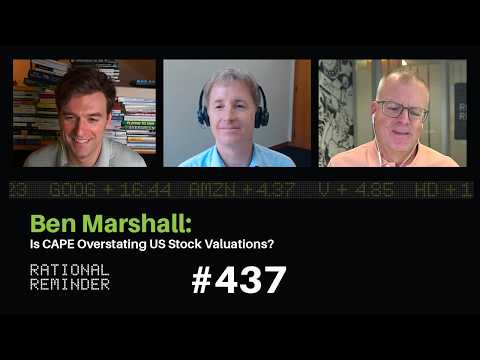
Ben Marshall: Is CAPE Overstating US Stock Valuations? | Rational Reminder 437
Watch
Ben Marshall discusses estimating expected equity market returns, the CAPE ratio, the component CAPE, and the permanent portfolio.
Watch on YouTube PodPulse
Finance & investing (evidence-based)Finance & investing (evidence-based)Futurism & technology and society
Cameron Passmore is a portfolio manager with PWL Capital Inc. and is securities-licensed by the Canadian Investment Regulatory Organization (CIRO). Benjamin Felix is a portfolio manager with PWL Capital Inc. and is securities-licensed by the Canadian Investment Regulatory Organi…
1:05:30Watch
Ben Marshall discusses estimating expected equity market returns, the CAPE ratio, the component CAPE, and the permanent portfolio.
Watch on YouTube
Ben Marshall explains why the component CAPE ratio, a value-weighted improvement on the traditional CAPE, yields better 10-year equity return forecasts.
 2:03:20
Watch
A podcast discussion on whether every Canadian needs a financial planner, covering the evolving profession, advice access, qualifications, and its future.
Watch on YouTubeListen1 h 50 min
Ben Felix becomes President of PWL Capital, reinforcing the firm's growth and culture. Tia Terramoto argues that financial planning is not one-size-fits-all; Canadians need to understand the diverse advice models, compensation structures, and the…
Listen 1:34:56
Watch
Martin Schmalz examines the winners and losers of index investing, common ownership, competition, investor behavior, and wealth management.
Watch on YouTubeListen1 h 21 min
An economist argues index funds benefit individual investors yet may raise prices and lower returns in equilibrium, explains why the wealthy resist indexing, and why economic thinking can undermine happiness.
Listen 1:45:44
Watch
A client interview with Brady Plunkett and Dr. Simon Bérubé leads into Ben Felix and Dan Bortolotti discussing their investment philosophies, personal portfolios, and financial trade-offs.
Watch on YouTubeListen1 h 30 min
Ben Felix and Dan Bortolotti reveal their personal investment portfolios, emphasizing that financial decisions often prioritize quality of life over wealth maximization, and that understanding trade-offs makes suboptimal choices rational.
ListenListen1 h 21 min
Dave Chilton reflects on the success of his Wealthy Barber Podcast and updated book, his upcoming retirement, and the state of Canadian personal finance.
ListenListen1 h 41 min
Researchers Chris Murray and Marco Salmon explain that leveraged ETFs target daily, not annual, returns and that long-horizon performance is governed by a convexity bonus and volatility drag.
ListenListen1 h 7 min
Behavioral finance discussion exploring how emotions, sports results, and weather influence stock markets. Covers investor errors like overreaction, reversal and value strategies, momentum effects, violations of the law of one price, and the importance of diversification, patience, and knowing one's competitive edge as an investor.
ListenListen1 h 6 min
This episode addresses listener feedback on a prior marriage finances discussion, highlighting blind spots around gendered spending roles, career sacrifices, and financial autonomy. The main segment debunks the myth that daily resets cause volatility decay in leveraged ETFs, explaining that volatility—not rebalancing frequency—is the real drag on r
ListenListen1 h 8 min
Victor Hagani discusses his heterogeneous agent model explaining market anomalies through three investor types: value investors, static allocators, and extrapolative return chasers. Topics include momentum vs. return chasing, the Merton Share framework, leverage considerations, critiques of long-short direct indexing, and findings from a Wall Stree
ListenListen1 h 5 min
Princeton economist Owen Zidar reveals that most American millionaires are ordinary Main Street business owners running unglamorous enterprises, not celebrity billionaires. The discussion covers how entrepreneurial income has driven inequality, the decline in labor's share of economic gains, stealth consolidation's impact on workers, and why early
ListenListen1 h 18 min
A litigation lawyer discusses what makes negligence claims against financial advisors successful, how Canadian courts determine fiduciary duty, the pitfalls of private assets for retail investors (including information asymmetry and liquidity gating), and the limited recourse available against finfluencers.
ListenListen1 h 8 min
This episode examines the financial dimensions of marriage through academic research, covering spending personality compatibility, prenuptial agreements, wedding costs, joint versus separate finances, and household decision-making dynamics. Key findings include that tightwads and spendthrifts often marry each other but experience more conflict, low
ListenListen1 h 24 min
Authors Philippa Hannay and Dr. Moira Summers discuss their book on financial misconduct, exploring why good people do bad things with other people's money. They emphasize behavioral ethics over traditional rule-based training, introduce a 12-step moral operating system for self-assessment, and highlight vulnerabilities like financial pressure, peo
ListenListen1 h 5 min
David Booth, Dimensional Fund Advisors co-founder, discusses 50+ years of evidence-based investing, from his shoe-selling lessons and outsider roots to academic finance breakthroughs with Gene Fama at Chicago. He emphasizes execution over ideas, critiques pure indexing, advocates market portfolios based on scientific optimism, and frames trust, tru
ListenListen1 h 24 min
Two One Digital executives discuss their people-first approach to AI transformation, advocating for amplifying employees rather than replacing them. They introduce frameworks for distinguishing irreducible human skills from reducible tasks, treating AI as hired talent, and measuring workforce intelligence through amplification scores.
ListenListen1 h 14 min
Two financial advisors debunk ten personal finance myths, including aggressive early saving, economic growth driving stock returns, dividend importance, index fund performance, gold as inflation hedge, and renting versus owning. They emphasize thoughtful balance over popular advice.
ListenListen54 min
Bill Bernstein discusses Jonathan Clements' posthumous book 'Money and Me,' exploring spending psychology, the four horsemen of economic risk, eudaimonic versus hedonic happiness, and the importance of giving money with 'warm hands' rather than bequeathing it to heirs.
ListenListen1 h 29 min
Barry Ritholtz discusses why investors make poor decisions despite abundant information, exploring cognitive biases, media manipulation, and the limits of expert forecasting. He shares foundational principles like Sturgeon's Law and the importance of indexing, humility, and behavioral discipline. The conversation covers portfolio concentration, alt
ListenListen1 h 36 min
Advisors discuss career advice for new planners, the theory and behavioral risks of borrowing to invest for young physicians, teaching kids about money, the value premium's behavioral endurance requirements, and strategies for managing sequence of withdrawals risk in retirement. Key insight: leverage and asset allocation decisions ultimately hinge
ListenListen1 h
Dr. Paul Kaplan explains lifecycle finance as a holistic framework for optimizing consumption, savings, and asset allocation across an individual's entire life. The discussion distinguishes risk tolerance from risk capacity, treats human capital as an asset class, and critiques the 4% rule in favor of utility-maximizing models. Listeners can access
ListenListen59 min
Hosts answer listener questions on diverse investing topics: ETF component trade-offs, defining true diversification, why active management underperforms at scale, treating defined benefit pensions in portfolios, Canadian fiduciary standards, individual stock picking vs indexing, international stock underperformance, and short-term savings for down
ListenListen1 h 20 min
Shannon Lee Simmons explains why people feel broke despite good incomes, citing social comparison and frictionless spending. She discusses retirement anxiety and anti-budgeting strategies. She argues human advisors remain essential for emotional financial decisions.
ListenListen1 h 15 min
Investors should prioritize simplicity through all-in-one asset allocation ETFs while understanding the nuances of home country bias. Financial planning provides more value than stock picking or complex DCF valuations. Behavior coaching helps align wealth with life goals.
ListenListen1 h 8 min
Market makers use creation-redemption to align ETF prices with underlying assets. Canada's retail-heavy market differs from the US in tax and structure. CRM3 disclosure and knowing that underlying securities drive liquidity are key for investors.
ListenListen50 min
Ben Carlson uses Japan's crash to argue for global diversification. He notes all-time highs are normal, timing is dangerous, and true risk is behavioral—your ability to stick with a plan through volatility, inflation, and crashes.
ListenListen1 h 17 min
An academic project improved planning simulations using empirical distributions instead of Gaussian models. Success rates barely changed, but median wealth rose while mean outcomes fell. The episode also covers geometric versus arithmetic returns and a client's switch from DIY investing to an advisor.
Listen