Scott Manley explores NASA's Vertical Motion Simulator at Ames Research Center, which trains Artemis astronauts for lunar landings, and tries the lunar lander controls himself.
A biochemist explains her synthetic 'Spud Cell' that grows and replicates but isn't alive, why chirality makes mirror-image life incompatible with ours, and how kill switches and open-source sharing could enable a bioeconomy by 2050.
An X-ray dimming of microquasar GRS 1915+105 led astronomers to peta-electronvolt gamma rays offset from the black hole, proving it accelerates protons and that microquasars can power the galaxy's cosmic rays.
BepiColombo reaches Mercury after eight years and nine gravity assists; new modeling supports a twice-Earth-size 'Planet X2' beyond Neptune; and dark energy may arise from the strong nuclear force's quantum vacuum without new particles.
Scott Manley is someone who fell into YouTube because he felt a deep compelling need to teach people orbital mechanics and rocket science so they could play Kerbal Space Program, now, years later the gaming videos are less important and the pure science is the main thrust. My de…
Scott Manley explores NASA's Vertical Motion Simulator at Ames Research Center, which trains Artemis astronauts for lunar landings, and tries the lunar lander controls himself.
Science meets pop culture on StarTalk! Astrophysicist & Hayden Planetarium director Neil deGrasse Tyson, his comic co-hosts, guest celebrities & scientists discuss astronomy, physics, and everything else about life in the universe. Keep Looking Up!
Discussions around tools and discoveries in the novel domain of multi-messenger and time domain astrophysics. We'll highlight recent publications, discuss tools to faciliate observations and generally talk about the cool science behind the most violent explosions in the universe.
Welcome to Eager Space I've been interested in spaceflight since I was very young, back in the days of project Gemini. My goal is to explain the spaceflight and rocket details that are often overlooked, be they technical details or explanations for why companies or organizations…
NASA's mission is to pioneer the future in space exploration, scientific discovery, and aeronautics research. To do that, we have worked around the world—and off it—for more than 60 years, searching for answers to fundamental questions about our place in the universe. We're expl…
Join Professor Fred Watson and Sci-Fi Author Andrew Dunkley on Space Nuts as they delve into astronomy, space travel, and cosmic mysteries. Explore groundbreaking discoveries and listener Q&A in captivating discussions. Follow us on social media to engage with our community!Two…
NASASpaceflight (NSF) delivers live rocket launch coverage, breaking spaceflight news, and in-depth reporting from around the world. NASASpaceflight is not affiliated with or does not represent the National Aeronautics and Space Administration (NASA). NASA initials used with NAS…
Welcome to the YouTube channel of the European Space Agency - ESA. ESA is Europe's gateway to space. Its mission is to shape the development of Europe's space capability and ensure that investment in space continues to deliver benefits to the citizens of Europe and the world. SP…
Planetary Radio brings you the human adventure across our Solar System and beyond. We visit each week with the scientists, engineers, leaders, advocates, and astronauts who are taking us across the final frontier. Regular features raise your space IQ while they put a smile on yo…
Hello! Welcome to the StarXiv, hosted by Dr Michelle Collins and Dr Payel Das. This is a biweekly podcast that delves into the latest astronomy papers & results from the arXiv. Michelle and Payel are astronomers at the University of Surrey. They love research, but struggle to fi…
Take a fact-based journey through the cosmos. Tune in to hear weekly discussions on astronomical topics ranging from planets to cosmology. Hosted by Fraser Cain (Universe Today) and Dr. Pamela L. Gay (Planetary Science Institute), this show brings the questions of an avid astron…
Hey hey! My name is Marcus House and I like space stuff. I hope to help you like space stuff too assuming you don't already. Eight years before I was born, Apollo 17 returned from the moon (1972). I sadly missed the most exciting adventure humans have ever experienced. Since I w…
Rocket science. A term we all use to describe something incredibly difficult. Trying to grasp all of the concepts involved in rocket science can be incredibly intimidating. My name’s Tim Dodd but I'm better known as the Everyday Astronaut. Recently I fell head over heels in love…
These podcasts are my discussion of NASA's Astronomy Picture of the Day. These are brief (3-5 minute) audio summaries of the picture posted on NASA's Picture of the Day website: APOD. Video versions of these are available on YouTube. I use these as the introduction to each of my…
Space, Technology, Discovery. Welcome fellow Curious Droids, I'm Paul Shillito founder of Curious Droid, the guy with not only the some of the loudest shirts on YouTube but also a huge curiosity about Aerospace history, robotics, transportation technology and other similar techy…
Astrophysics for All is a student-led podcast that brings astrophysics down to Earth for curious young people everywhere. Each episode features conversations with professional astronomers and researchers, breaking down big ideas about the universe in a way that’s clear and engag…
Mid-century history, mostly about science and technology. Long-form videos every few weeks; shorts five days a week. My third book is scheduled for Spring 2027!
A biochemist explains her synthetic 'Spud Cell' that grows and replicates but isn't alive, why chirality makes mirror-image life incompatible with ours, and how kill switches and open-source sharing could enable a bioeconomy by 2050.
Physicist Francis Halzen explains how IceCube, a cubic kilometer of Antarctic ice, catches rare cosmic neutrinos via Cherenkov light, identified NGC 1068 as a cosmic-ray source, and, per the hosts, earned a Nobel Prize.
An X-ray dimming of microquasar GRS 1915+105 led astronomers to peta-electronvolt gamma rays offset from the black hole, proving it accelerates protons and that microquasars can power the galaxy's cosmic rays.
The two-second rule for classifying gamma-ray bursts is failing; new research shows early X-ray 'embers' cleanly separate collapsars from neutron-star mergers, even with the Einstein Probe's limited soft X-ray data.
BepiColombo reaches Mercury after eight years and nine gravity assists; new modeling supports a twice-Earth-size 'Planet X2' beyond Neptune; and dark energy may arise from the strong nuclear force's quantum vacuum without new particles.
Listeners' questions on exoplanet axial tilt, frozen matter at black hole event horizons, helium stars, and Foundation's black-hole jump drive, answered via transit statistics, spectroscopy and fusion basics.
SpaceX update covering Starship Flights 16 and 17 preparations at Starbase, including Ship and Booster testing, launch site work, and infrastructure milestones.
BepiColombo enters Mercury orbit after a glitch-shortened capture burn, while archive interviews recall MESSENGER's finds: volatile-rich surface, polar water ice, and an offset magnetic field.
Planetary scientist Jim Bell explains when space images become art — through intentional framing and enhanced color — tracing blue Martian sunsets, relay-enabled bandwidth, and his book The Art of the Cosmos.
Discussion of four astronomy papers covering Milky Way structure clustering, a giant dark matter core in a dwarf galaxy, potassium production via CO shell mergers, and new dwarf galaxy discoveries from Euclid's first data release.
Two astronomers review four new papers: comets likely can't deliver enough hydrogen cyanide to seed life on Earth, dwarf-galaxy starbursts stay spatially extended, and local analogues probe little red dots' X-ray weakness.
Physicists debate how dark matter will finally be identified: via direct detection, precision lepton colliders, the cosmic neutrino background, and null results that constrain what it cannot be.
New surveys like Roman, Rubin, Euclid and Sphere X are shifting cosmology from proving dark matter and dark energy exist to pinning down their properties, with the universe itself as the laboratory.
Two amateur astronomers tour November's Messier objects, from the Ring Nebula's elusive central star to the faint Jones 1 planetary, mixing eyepiece sketches, star-hopping tips, and cold-weather gear advice.
Two amateur astronomers swap practical tips on observing chairs, stools, mount tweaks and keeping eyepieces warm in a cold observatory, while celebrating club talks, the ALT-As conference and David Eicher's return to Sky & Telescope.
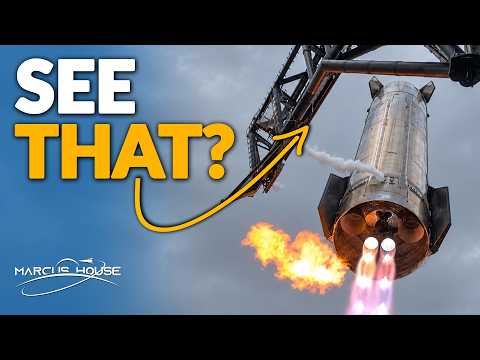
The video examines SpaceX's first Starship catch with new camera angles, alongside updates on Flight 16 and 17 vehicles, ULA's Vulcan Centaur, Amazon Leo, and Voyager 1.
The video reviews SpaceX’s first Starship catch on Flight 15, Super Heavy’s aborted catch attempt, cryogenic propellant challenges, and other spaceflight developments.
JPL Director Dave Gallagher and Blue Origin CEO Dave Limp discuss lunar exploration, planetary protection, and partnerships for advancing space exploration.
A 4K slow-motion super cut with raw audio of SpaceX's 15th Starship flight, showing the aborted Booster catch and the first-ever Starship catch at Starbase, TX.
SpaceX's first Starship ship catch marks an inflection point, while Vulcan's booster failure and China's lunar timeline push NASA and the Space Force to rethink how they buy launch and lunar transport.
NASA's Artemis updates reveal divergent paths for lunar landing: Blue Origin's multi-stage approach versus SpaceX's high-frequency refueling model, while reinforcing the central role of the SLS in lunar architecture.
The video covers the Oil Sniffer scam, tracing it from the 1970s oil crisis through its mysterious inventors to French oil company Elf Aquitaine's investment.
SpaceX covers the first orbital Starship launch carrying advanced Starlink satellites, drawing on more than a dozen flight tests and years of development.
An astronomy podcast explains a photograph from Iceland showing geothermal fumaroles releasing steam beneath green auroral bands, describing how Earth's internal heat produces the plumes while solar wind interacting with the magnetic field creates…
The Cepheus Flare molecular cloud complex contains interstellar dust that scatters blue light and obscures background stars, creating a nursery for new star formation 1200 light years away.
The creator examines whether asteroids of different sizes could be deflected from hitting Earth, citing NASA’s DART mission and considering 100m, 1km, and 5km cases.
The Pershing II missile terrified the Soviets into scrapping their best weapon, the SS-20, due to its revolutionary radar-guided accuracy and 8-10 minute strike time from West Germany. The 1987 INF Treaty eliminated these missiles, but the technology lived on in B61 bombs, missile defense targets, and modern systems like China's DF-21D and the US T
Dr. Kishile Day discusses "cosmic fireworks"—explosive stellar events like supernovae, stellar mergers, and planetary engulfment—and how multi-wavelength and gravitational wave observations reveal them. He shares the story of discovering a star swallowing its own planet and offers advice for aspiring astronomers.
Professor Robert Simcoe discusses spectroscopy, a method for studying the physical properties of distant stars and galaxies. He emphasizes that scientific research is driven by a persistent, childlike curiosity and explains why studying the early universe helps us understand our cosmic origin story.

 53:07