Matt Duss argues the US should pursue coexistence with China rather than define foreign policy through a 'China lens,' and urges Democrats to counter anti-China politics by targeting corporate oligarchs at home rather than out-hawking the GOP.
The hosts argue that Trump's intervention to reinstate NVIDIA's CEO, amid an espionage scandal and export control violations, represents a catastrophic erosion of the rule of law, corporate governance, and the integrity of US financial markets…
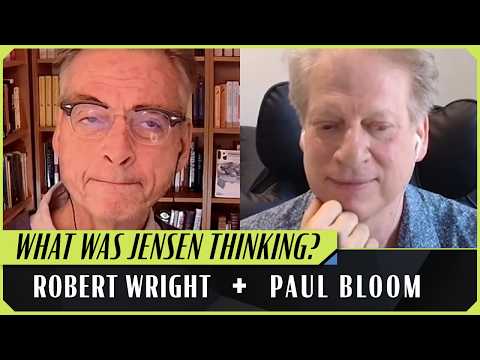
The hosts debate the implications of Jensen Huang's return to NVIDIA, arguing that U.S. export controls on China are counterproductive in a multipolar world.
Wolfgang Schmidt says Russian hybrid attacks on Germany are rising, the AfD leads polls but won't govern, and Germany's economy faces painful change — yet Europe shouldn't be written off.
Nvidia’s AI chip exports, enabled by Trump‑era political favors, risk ending up in weapons used by autocratic regimes, posing a national‑security scandal.
A weekly discussion of current affairs in China with journalists, writers, academics, policymakers, business people and anyone with something compelling to say about the country that's reshaping the world. Hosted by Kaiser Kuo.
Matt Duss argues the US should pursue coexistence with China rather than define foreign policy through a 'China lens,' and urges Democrats to counter anti-China politics by targeting corporate oligarchs at home rather than out-hawking the GOP.
Joe Studwell argues Africa's poverty stems from low population density and low-budget colonialism, not corruption or ethnicity, and that successful African states follow the same agriculture-first, export-manufacturing, finance-manipulating…
The Munk Debates podcast is an extension of the main stage events - in subject, speaker selection, tone and format. It will introduce the iconic brand - and its engaging debates about significant issues of our time. Audiences will hear strong and passionate arguments from both s…
Geopolitical Cousins throws together analysts Jacob Shapiro and Marko Papic for some of the most in-depth, off-the-wall geopolitical analysis in the world.
The hosts debate the implications of Jensen Huang's return to NVIDIA, arguing that U.S. export controls on China are counterproductive in a multipolar world.
Gideon Rachman, the Financial Times chief foreign affairs columnist talks to the decision-makers and thinkers who are shaping world affairs. Hosted on Acast. See acast.com/privacy for more information.
Foreign Policy economics columnist Adam Tooze, a history professor and a popular author, is encyclopedic about basically everything: from the COVID shutdown, to climate change, to pasta sauce. On our new podcast, Tooze and FP deputy editor Cameron Abadi will look at two data poi…
This series features brief discussions with leading China experts on a range of issues in the U.S.-China relationship, including domestic politics, foreign policy, economics, security, culture, the environment, and areas of global concern. For more interviews, videos, and links…
The Council on Foreign Relations is an independent, nonpartisan membership organization, think tank, and publisher dedicated to being a resource for its members, government officials, business executives, journalists, educators and students, civic and religious leaders, and othe…
Deep Dish on Global Affairs helps you make sense of our rapidly changing world. Join host Leslie Vinjamuri, President and CEO of the Chicago Council on Global Affairs, as she speaks with thought leaders, journalists, and experts shaping foreign policy and global events. Together…
She hunted the world’s most dangerous terrorists. Now, former CIA Targeter Sarah Adams breaks down global news and emerging threats, helping everyday people stay informed. prepared, and ready.
Each week, Foreign Policy Live will feature a substantive conversation on world affairs. Host and FP editor in chief Ravi Agrawal will be joined by leading foreign-policy thinkers and practitioners to analyze a key issue in global politics, from the U.S.-China relationship to co…
A bunch of unedited stuff about international relations, American politics, political economy, the marketplace of ideas, and popular culture written by this Drezner guy
Trump’s pressure forced Nvidia’s board to reinstate Jensen Huang, sparking a market surge but raising alarms about political bailouts, export‑control erosion, and rule‑of‑law weakening.
A new show and vertical focused on defense tech and the defense industrial base, created and produced by WAR ON THE ROCKS and supported by BOOZ ALLEN HAMILTON.
Defense leaders argue power—not sensors—is the bottleneck to battlefield autonomy: the Army has a distribution problem, not a generation one, and needs standardized, software-managed, low-signature energy treated as a class of supply.
Fault Lines, the National Security Institute’s flagship podcast, gets you quickly up to speed, three-times-a-week, on the national security and foreign policy debates shaking up America.Our regular cast of foreign policy experts includes NSI Founder and Executive Director Jamil…
This is The Lede, the New Lines Magazine podcast. Each week, we delve into the biggest ideas, events and personalities from around the world. For more stories from New Lines, visit our website, newlinesmag.com
Simon Winder argues James Bond endured as a comforting myth of British global relevance during post-imperial decline, and weighs Robert Pattinson's casting and his new county-by-county history of England.
The preeminent podcast for all things drones, defense tech, defense policy, and modern warfare. Featured guests include industry leaders, policy experts, military warfighters, business titans, and many more. Hosted by Steve Simoni, co-founder and President of Allen Control Syste…
Join ex-CIA officer John Kiriakou on a very personal deep dive into what makes a spy tick. One of the most famous spies in the whole world, John - a spy with a conscience - blew the whistle on the CIA's torture program after the war on terror and spent 23 months in federal priso…
Geopolitics Decanted is a podcast featuring geopolitical analysis and in-depth expert interviews on topics ranging from War in Ukraine, Great Power Competition with China, changing nature of warfare, sanctions and export controls, semiconductors and cybersecurity. This is a podc…
The Rest Is Politics’ Alastair Campbell and Rory Stewart interview politicians, leaders, intellectuals, and more. From inside and outside of politics, guests join Rory and Alastair to discuss life, leadership, and the philosophy that’s led them to success in their chosen field.…
Welcome to my Channel. I try to do researched content about various topics ranging from history, anthropology, geography, culture and more and more and more. I have a long list, and yeah I actually have a list of videos that I want to make in the future. I constantly update that…
The Shenzhen summit of Xi, Trump and Putin yielded a symbolic “Declaration of Peace” but little concrete progress, raising concerns about nuclear proliferation, UN reform and U.S. foreign‑policy direction.
"Unconventional Knowledge by GIS" is a podcast dedicated to providing in-depth analysis of critical global issues. Each episode features top-level insiders from various fields, offering insights into complex geopolitical, economic and security topics that shape the international…
Channel tackling global issues from the fields of geopolitics, international relations, economy, technology, which shape the world of today. To sponsor my channel, you can see my price, availability, and stats: https://app.thoughtleaders.io/#/reserve/Good-Times-Bad-Times For spo…
Welcome to Debating Canadian Defence! This newsletter will discuss Canadian defence issues of the day. I'll mostly address matters that are in the media, along with procurement announcements and developments. What will readers get out of this newsletter
The hosts argue that Trump's intervention to reinstate NVIDIA's CEO, amid an espionage scandal and export control violations, represents a catastrophic erosion of the rule of law, corporate governance, and the integrity of US financial markets…
Andrew Coyne argues Trump's intervention to reinstate NVIDIA's disgraced CEO spreads the White House ethics collapse into Wall Street, swapping trust-based capitalism for crony capitalism.
The hosts break down a sweeping Democratic midterm win, its 2028 Senate implications, and warn that both parties' drift toward China hawkishness — and the tech world's one-sided political spending — are strategic blunders in a transactional…
Ukraine’s recent strikes crippled the Kerch bridge, disrupting Russian supply lines to Crimea and delivering a strategic blow amid Putin’s China visit.
Wolfgang Schmidt says Russian hybrid attacks on Germany are rising, the AfD leads polls but won't govern, and Germany's economy faces painful change — yet Europe shouldn't be written off.
The Xi-Trump-Putin summit was a symbolic victory for China, projecting equality with the US and Russia's secondary status, but the underlying US-China relationship remains fraught with tension over trade, tech, and Taiwan.
Nvidia’s AI chip exports, enabled by Trump‑era political favors, risk ending up in weapons used by autocratic regimes, posing a national‑security scandal.
The text links historic and recent voter suppression, especially under Trump, and lists alleged corruption ties between the administration, defense firms, and crypto ventures.
The newsletter announces a Thanksgiving break, previews coverage of the USTR Section 301 report, Nvidia fallout, Dutch FM's Beijing visit, and CICIR security risks, noting USTR concerns about Chinese transshipment and investment.
The article argues that critics habitually downplay China’s economy and lists headlines including Chen Jining’s investigation, chip controls, and the Shenzhou‑24 mission.
An economics podcast argues Trump's reinstatement of NVIDIA's CEO and the market's 30% surge reveal 'speedball capitalism,' then traces the cornucopia's 2,500-year symbolism from Greek myth to green-growth and AI abundance debates.
US grid growth slowed to 0.6% (2017–24), spurring Senate permitting reform that splits labor from environmental groups; a Trump-Xi-Putin summit draws Yalta comparisons that Adam Tooze argues misread both history and today's power balance.
The video discusses what the creator describes as America's CEO problem, using the Jensen Huang scandal to examine national security risks tied to corporate leadership.
Experts say the Shenzhen APEC summit and first US-China-Russia trilateral delivered optics over substance; the December G20 in Miami will hinge on extending the expiring trade truce and whether the new AI crisis channel can be structured to work.
A Peruvian expert explains how the new Chancay port anchors decades-deep but asymmetric China–Peru ties, and why Peru pragmatically balances Chinese commerce against broader US security and educational links.
Council on Foreign Relations host Rebecca Patterson reacts to Nvidia's reinstatement of Jensen Huang as CEO following President Trump's intervention and what it means for markets and the AI race.
Volker Türk asserts that international law remains a vital "compass" for holding powerful nations accountable, even as the US withdraws from UN human‑rights bodies and modern conflicts threaten civilian safety.
Mark Leonard warns that a US midterm setback and a "crisis of liberalism" are driving Europe’s far‑right rise and reducing its reliance on US security guarantees.
Former Army counterintelligence officer Layla Collins warns host Sarah Adams that post-9/11 threat patterns are repeating — from ghost drivers filming US bases to AI-amplified manipulation of Wikipedia, polls, and public perception.
A former YPG commander details his combat experience against ISIS and delivers a scathing critique of the West's betrayal of the Kurds by legitimizing Al-Qaeda leader Jolani, calling it a catastrophic strategic blunder that empowers global jihad.
Coups are resurging after decades of decline, with Africa seeing eleven since 2020 and coup‑like constitutional crises emerging in South Korea, Brazil, and the United States.
Corruption fused with affordability anger drove the midterms; without the White House, Democrats' best anti-corruption tools are investigations, subpoenas and veto-bait bills, with campaign finance reform at the core.
An Iran expert argues Trump's post-midterm options on the Iran war all fail: the blockade is unsustainable, Iran's slow economic squeeze is working, and the era of US-imposed order in the Middle East is ending.
The article argues that personal bonds between leaders, as praised after the Putin‑Trump‑Xi summit, are insufficient for real diplomatic progress and that Trump’s overtures to autocrats are largely symbolic and counterproductive.
Experts discuss rebuilding the U.S. munitions supply chain through vertical integration, strategic capital, and long-term demand signals, while addressing critical mineral dependencies and the need for both high-end and low-cost munitions.
NSI fellows debate Russian missiles striking Poland, U.S. curbs on Ukrainian deep strikes, and whether NATO-like paper guarantees can deter Putin, urging stronger air defenses and congressional guardrails.
Panel debates Hegseth's new U.S.-Venezuela defense pact, its oil implications, his congressional troubles, and the Essequibo dispute that could destabilize Guyana.
Scholars argue the 'Shia Crescent' myth wrongly casts Arab Shia communities as Iranian puppets; from Iraq to Lebanon, local politics, corruption and generational change drive Shia aspirations more than Tehran's agenda.
Sam Spencer Pittman explains Army Fuse's venture-style approach to funding defense tech, while Steve argues that manufacturing is too specialized for horizontal investment and that primes' lock-in remains the biggest hurdle for startups.
Amprius CEO Tom Stepping explains how silicon-anode batteries double energy density to extend drone flight times, and how US industrial policy and NDAA rules are reshaping battery supply chains away from China.
Explores whether the 1986 assassination of Swedish PM Olaf Palma was hidden inside a security exercise, tracing apartheid spy Craig Williamson, fixer Bertil Wedin, suspect Anders Larsson, and NATO stay-behind weapon caches.
A Finnish-speaking armed man with a walkie-talkie was at the murder scene, undermining the lone-killer theory; the PKK lead collapsed, Petterson's conviction was overturned, and an arms dealer held the exact murder bullet type.
Two former Biden White House AI officials defend chip export controls, call China's 6-9 month model lag a policy choice, and argue public trust and government speed will decide the US-China AI race.
Modern warfare is shifting toward long-range strike capabilities and unmanned systems. War games suggest NATO's decision-making and nuclear hesitation are key vulnerabilities against Russian aggression. Success in future conflicts requires indigenous industrial production and the integration of new technologies into traditional combined arms maneuv
Thant Myint-U and Rory Stewart argue the world is dangerously close to major war, lacking a modern 'theory of peace'. They critique the UN's shift from peacemaking to interventionism, using Myanmar's crisis and U Thant's legacy as contrasting…
Ukraine war lessons go beyond drones and AI: precision, mass, attrition, campaigning and territorial control still matter, and the US risks learning the wrong lessons without embedded observers or structural reform.
Analysts weigh Taiwan's local elections, its resilience and defense-budget struggles, frozen US arms sales, Chinese probing, and whether the fragile US-China détente can hold.
Democrats risk overreaching without a clear mandate; the author urges focused bipartisan legislation, cautions on Iran policy, and highlights a Nvidia‑China espionage scandal.
CaspianReport examines how the world's oceans are being divided as powerful countries compete for shipping routes and resources, with Trump potentially giving China an excuse.
Asia is moving beyond the software narrative to dominate the trillion-dollar physical infrastructure of AI. Taiwan, Japan, and South Korea are leveraging manufacturing and memory chip dominance to drive unprecedented national growth.
Migrant surges at the Spanish-Moroccan border reveal how migration has become a geopolitical bargaining chip. Driven by youth disillusionment, both Europe and North Africa weaponize borders and visas, exposing a shared generational crisis of…
C‑40 makes the Defence Investment Agency a Crown corporation with a new Associate Minister for Procurement, boosting operational flexibility while keeping ministerial oversight. Benefits include faster procurement and better alignment with defence, but risks remain around accountability and sole‑source authority.
The article examines how disputes over military requirements are straining relations between Canadian ministers and the CAF, reviving patterns seen under Harper that have returned under the Carney government. It notes that vague goals like an 'operational advantage' push the CAF toward U.S. systems, clashing with aims to boost Canadian industry and