58:30
What Happens If You Just Keep Going?
The video explores what happens as you keep traveling outward through space, progressing through interplanetary, interstellar, intergalactic, and intercosmic scales.
Watch on YouTube PodPulse
Curated sources for Cosmology & astrophysics in Physics, Space & Chemistry, with summaries of their latest episodes.
5 curated podcasts7 curated YouTube channels0 curated newslettersCurated newsletters for this section are in review.
58:30The video explores what happens as you keep traveling outward through space, progressing through interplanetary, interstellar, intergalactic, and intercosmic scales.
Watch on YouTube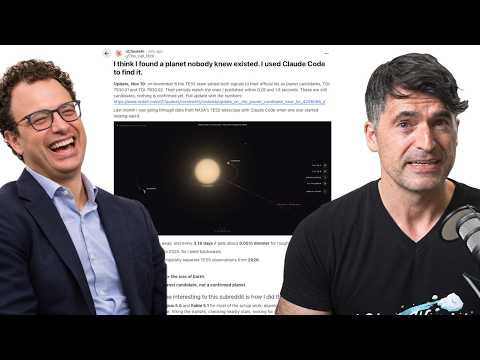 23:43
Also indexed: 964 sourcesIndexed sources are summarized but not yet reviewed for Explore.
WatchCool Worlds
The video discusses AI, specifically Claude, being used to detect exoplanets, with the creator sharing thoughts on AI's potential role in science.
Watch on YouTube
Listen58 minStarTalk
A biochemist explains her synthetic 'Spud Cell' that grows and replicates but isn't alive, why chirality makes mirror-image life incompatible with ours, and how kill switches and open-source sharing could enable a bioeconomy by 2050.
Listen
Listen11 minMulti-messenger astrophysics
An X-ray dimming of microquasar GRS 1915+105 led astronomers to peta-electronvolt gamma rays offset from the black hole, proving it accelerates protons and that microquasars can power the galaxy's cosmic rays.
Listen 25:13
WatchDr. Becky
A visit to ESO headquarters discussing the Extremely Large Telescope, covering exoplanets, stars orbiting black holes, galaxies, and the distant universe.
Watch on YouTube 33:18
WatchIsaac Arthur
The video explores how future humans might be born, raised, and live as children, including artificial wombs, engineered traits, and childhoods among the stars.
Watch on YouTubeCreated and narrated by David Kelly. I am also behind History of Humankind and Voices of the Past. I also run History of the Earth with my brother Peter - who is History Time too. The entire history of the universe, one trillionth of a second at a time. Business enquiries: histo…
58:30Watch
The video explores what happens as you keep traveling outward through space, progressing through interplanetary, interstellar, intergalactic, and intercosmic scales.
Watch on YouTube 57:28
Watch
The video examines whether the entire universe is quantumly entangled, covering Einstein and Bohr, an experiment, and its meaning.
Watch on YouTubeSpace, astronomy, exoplanets, astroengineering and the search for extraterrestrial life & intelligence. The Cool Worlds Lab (http://coolworldslab.com), based at the Department of Astronomy, Columbia University, is a team of astronomers seeking to discover and understand alien wo…
Conversations: AI & scienceCosmology & astrophysicsSpace exploration & spaceflight
Science meets pop culture on StarTalk! Astrophysicist & Hayden Planetarium director Neil deGrasse Tyson, his comic co-hosts, guest celebrities & scientists discuss astronomy, physics, and everything else about life in the universe. Keep Looking Up!
Cosmology & astrophysicsSpace exploration & spaceflight
Discussions around tools and discoveries in the novel domain of multi-messenger and time domain astrophysics. We'll highlight recent publications, discuss tools to faciliate observations and generally talk about the cool science behind the most violent explosions in the universe.
I'm Dr Becky Smethurst, an astrophysicist at the University of Oxford. I love making videos about science with an unnatural level of enthusiasm. I like to focus on how we know things, not just what we know. And especially, the things we still don't know. If you've ever wondered…
This channel focuses on exploring concepts in science with an emphasis on futurism and space exploration, along with a healthy dose of science fiction. While we explore many concepts and technologies that are far beyond us now, we try to keep everything inside the bounds of know…
Space Time explores the outer reaches of space, the craziness of astrophysics, the possibilities of sci-fi, and anything else you can think of beyond Planet Earth with our astrophysicist host: Matthew O’Dowd. For all business inquiries and sponsorship opportunities please reach…
Cosmology & astrophysicsSpace exploration & spaceflight
Hello! Welcome to the StarXiv, hosted by Dr Michelle Collins and Dr Payel Das. This is a biweekly podcast that delves into the latest astronomy papers & results from the arXiv. Michelle and Payel are astronomers at the University of Surrey. They love research, but struggle to fi…
Cosmology & astrophysicsSpace exploration & spaceflight
Take a fact-based journey through the cosmos. Tune in to hear weekly discussions on astronomical topics ranging from planets to cosmology. Hosted by Fraser Cain (Universe Today) and Dr. Pamela L. Gay (Planetary Science Institute), this show brings the questions of an avid astron…
Author and futurist John Michael Godier explores the universe in weekly documentary videos released randomly. These videos center on science, future technology and the mysteries of the universe. Additionally, John releases irregular videos covering breaking news on important dev…
Cosmology & astrophysicsSpace exploration & spaceflight
Astrophysics for All is a student-led podcast that brings astrophysics down to Earth for curious young people everywhere. Each episode features conversations with professional astronomers and researchers, breaking down big ideas about the universe in a way that’s clear and engag…
Official YouTube Channel for the works of celebrated scientist and astronomer Carl Sagan.
No recent summaries yet.
The video discusses AI, specifically Claude, being used to detect exoplanets, with the creator sharing thoughts on AI's potential role in science.
 13:02
Watch
Cool Worlds visits New York City physicists creating exotic quantum matter to show how extremely cold conditions are achieved.
Watch on YouTubeListen58 min
A biochemist explains her synthetic 'Spud Cell' that grows and replicates but isn't alive, why chirality makes mirror-image life incompatible with ours, and how kill switches and open-source sharing could enable a bioeconomy by 2050.
ListenListen58 min
Physicist Francis Halzen explains how IceCube, a cubic kilometer of Antarctic ice, catches rare cosmic neutrinos via Cherenkov light, identified NGC 1068 as a cosmic-ray source, and, per the hosts, earned a Nobel Prize.
ListenAn X-ray dimming of microquasar GRS 1915+105 led astronomers to peta-electronvolt gamma rays offset from the black hole, proving it accelerates protons and that microquasars can power the galaxy's cosmic rays.
Listen23 min
The two-second rule for classifying gamma-ray bursts is failing; new research shows early X-ray 'embers' cleanly separate collapsars from neutron-star mergers, even with the Einstein Probe's limited soft X-ray data.
ListenA visit to ESO headquarters discussing the Extremely Large Telescope, covering exoplanets, stars orbiting black holes, galaxies, and the distant universe.
 26:09
Watch
Research suggests comets did not supply early-Earth life ingredients; the episode also covers MMX, telescope updates, and Geminid viewing.
Watch on YouTubeThe video explores how future humans might be born, raised, and live as children, including artificial wombs, engineered traits, and childhoods among the stars.
 29:31
Watch
The video explores how early intelligent civilizations could have appeared in the universe and why their descendants are not visibly present.
Watch on YouTubeThe video discusses new 3D maps of the universe's dark matter and how they may conflict with current theories of cosmic evolution, dark energy, and expansion.
 24:46
Watch
PBS Space Time examines how AI is being applied to mathematics and theoretical physics, from solving longstanding problems to designing experiments.
Watch on YouTubeDiscussion of four astronomy papers covering Milky Way structure clustering, a giant dark matter core in a dwarf galaxy, potassium production via CO shell mergers, and new dwarf galaxy discoveries from Euclid's first data release.
Listen33 min
Two astronomers review four new papers: comets likely can't deliver enough hydrogen cyanide to seed life on Earth, dwarf-galaxy starbursts stay spatially extended, and local analogues probe little red dots' X-ray weakness.
ListenPhysicists debate how dark matter will finally be identified: via direct detection, precision lepton colliders, the cosmic neutrino background, and null results that constrain what it cannot be.

Listen30 min
New surveys like Roman, Rubin, Euclid and Sphere X are shifting cosmology from proving dark matter and dark energy exist to pinning down their properties, with the universe itself as the laboratory.
ListenThe video explores a SETI experiment reporting 25 new candidate signals at the anti-solar point.
 16:17
Watch
An update on KIC 8462852, also known as Tabby's Star, described as an enigmatic dimming star.
Watch on YouTubeDr. Kishile Day discusses "cosmic fireworks"—explosive stellar events like supernovae, stellar mergers, and planetary engulfment—and how multi-wavelength and gravitational wave observations reveal them. He shares the story of discovering a star swallowing its own planet and offers advice for aspiring astronomers.
Listen27 min
Professor Robert Simcoe discusses spectroscopy, a method for studying the physical properties of distant stars and galaxies. He emphasizes that scientific research is driven by a persistent, childlike curiosity and explains why studying the early universe helps us understand our cosmic origin story.
Listen